
New year, new look, same great content!
What’s Keeping Everyone Up at Night?
We’ve been doing survey work with digital shop owners for a while now (time flies when you’re having fun!). One of the questions we frequently ask is something along the lines of:
We stack rank these collective challenges to try to understand the overall themes in the industry. Something that always seems to be near the top of these lists is profitability.
It’s not just general profitability though.
Owners aren’t just trying to juice up numbers for a quick sale. Most are interested in steady, reliable, profitability. Something they can budget against. Something that won’t disappear for seemingly no reason next month.
There are essentially three levers you can pull to appreciably influence your profitability.
Pricing
This is something we’ve harped on for a while now so I’ll leave it at this: if you haven’t touched your rates in the last year or so, raise your prices. If you’re uncomfortable doing this, invest in better positioning. Properly positioned dev shops should have no trouble with $150-200/hr. I’m happy to help with this.
Productive Utilization
Literally, the only reason to keep accurate timesheets. Depending on who you ask, industry benchmarks can vary widely on this. If you’re just starting out optimizing this, ignore your whole-firm utilization and just shoot for a production (dev/design/marketing) utilization rate of around 85%. Project managers should be around 50%. Account managers around 70%. Management, near zero. This is slightly lower than normal but we’re all a bit tired at this point. Plus, anyone who tells you they’re consistently productive for 8hrs each day is lying. There are too many meetings, too many interruptions, and too much context switching required for that to be a reality.
Overhead
If you’ve successfully ignored your whole-firm utilization rate, this is where you’ll have to keep an eye on support costs. Overhead, while non-billable (and thus non-profitable), should be viewed as the comfortable support level required to run your firm effectively. Sometimes spending here can lead to savings elsewhere. E.g. spending a bit on employee happiness could lower your recruitment costs or reduce your turnover risk. Basically, this isn’t a place to never spend but you have to keep it under control. Normally, that’d be sub 35%.
As far as reliability goes, keeping up with pricing is pretty easy. Take a look at the market periodically and adjust. We typically publish new pricing surveys annually but you can get a decent idea just by having candid conversations with your prospects. Overhead is also comparatively easy to keep in check. Utilization, now that’s the bear. Getting that right takes strong incentives, efficient workflows, an appropriately skilled team, solid reporting, and a robust sales pipeline. None of those are simple to pull off but making a dent in any of them will improve your bottom line.
Manage those three levers well and you’ll be sleeping much better.
Data Point
Recent survey results, benchmark data, industry metrics, analysis, and new survey opportunities.
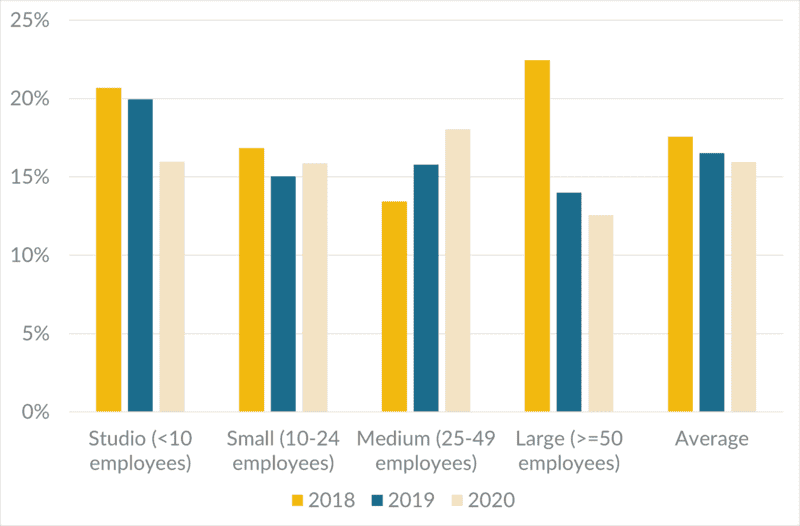
The average net margin for a digital agency is about 16% from 2018-2020. While this is a healthy margin, it’s not uncommon to see shops with net income margins of 25% or 30%. They tend to be able to charge significantly higher than average hourly rates, have excellent utilization rates, and control their overhead while still providing a solid support structure for their firm.
 |
New Insights
Our latest articles about running a digital agency.
 |
The Future of Running a Digital Agency
|
 |
Understanding Your Agency’s Employee Utilization Rate
|
 |
Creating Your Agency Roadmap
|