
2026 Edition · Agency Revenue Generation
Digital Agency
Growth Guide
Last updated: June 2026
Most digital agencies grow through a mix of strategy, luck, and personal heroics from their owners. A small but expanding group has changed that by treating revenue generation as one integrated system. They grow faster, earn higher margins, and widen the gap every year.
Put this to work for your shop with a Digital Agency Growth Review
2026 Edition · Agency Revenue Generation
A widening divide
Revenue generation at digital agencies often depends on a mix of strategy, luck, and personal heroics from owners and partners. For most of the industry, revgen is broken. These agencies live with uneven sales and siloed departments that are not built to work together. A small but expanding part of the industry has changed its approach, raising the sophistication of how it generates revenue.
These leaders systematize referral generation, grow current accounts, and extend client tenure. They fully integrate the four revenue functions of sales, marketing, business development, and account management, and focus their effort on a few high-value areas. That lets them grow faster while earning higher margins, which they reinvest, widening the divide between the leaders and everyone else.
In our research, the greatest leverage sits in account management. Growing, upselling, cross-selling, and retaining existing accounts produces more revenue per unit of effort than any acquisition channel we measure. The second opportunity is referrals, the channel with the lowest acquisition costs and longest tenures we have measured. AI is the third area where leaders are pulling away, using it to enhance relationship-driven revgen work while most agencies confine it to production.
Leaders who invest in their revenue generation system keep extending their advantage in growth and margin. Agencies can reach growth rates two to three times the industry average, with margins that are multiples of a standard agency. The shifts we tracked from 2015 to 2020 have accelerated sharply since 2021, and the gap gets harder to close every year an agency waits.
Nicholas Petroski · Founder, Promethean Research
Contents
What this guide covers
A practical map of how digital agencies grow in 2026, from the data on the typical agency to the system the fastest-growing shops use to pull ahead.
The four functions of a digital agency
Leadership, revgen, production, support, and the four functions inside revgen.
Benchmarking the typical agency
2026 data on growth, pricing, service mix, and headcount.
Why revenue generation is broken
The four failure modes that stall growth.
Strategy and positioning
Specialization and selling against the problem space.
How digital agencies actually grow
The tactics that work and the buyer shift behind them.
The integrated revgen system
Unifying sales, marketing, bizdev, and account management.
Growing through account management
LTV and CAC, retention, tiering, and compensation.
The referral engine
The lowest-cost, longest-tenure channel and the IRP.
AI inside the revgen system
Where AI works, where sales lags, and pricing pressure.
Where the market goes from here
The widening divide and the path forward.
01
The four functions of a digital agency
The way agencies organize changes over time, but the core functions stay consistent: Leadership, Revenue Generation (Revgen), Production, and Support. Leadership sets the direction. Revgen brings in business. Production delivers the work that revgen sells. Support keeps the business running.

"Your firm exists primarily for two reasons, and we can throw a third one in there if all the stars align."
Baker's foreword argues that a firm exists first to move the needle on behalf of its clients, second to make real money, and only third to love the work. Put effectiveness and profit first and the love follows.
The four functions inside revgen
Revgen itself breaks into four functions, and most agencies misunderstand how they fit together. Business development builds strategic partnerships that create new opportunities. Marketing attracts prospects, warms up leads, and makes it easier for sales to close the right accounts. Sales converts leads into clients. Account management owns the post-sale relationship, client retention, and account expansion, and is directly responsible for revenue through the growth and referrals of existing accounts.
In a healthy system, the four functions reinforce each other. Marketing builds the assets sales uses to close. Sales feeds marketing intelligence about what resonates. Account management produces an experience that generates referrals. Business development and marketing turn those referrals into repeatable channels.
02
Benchmarking the typical agency in 2026
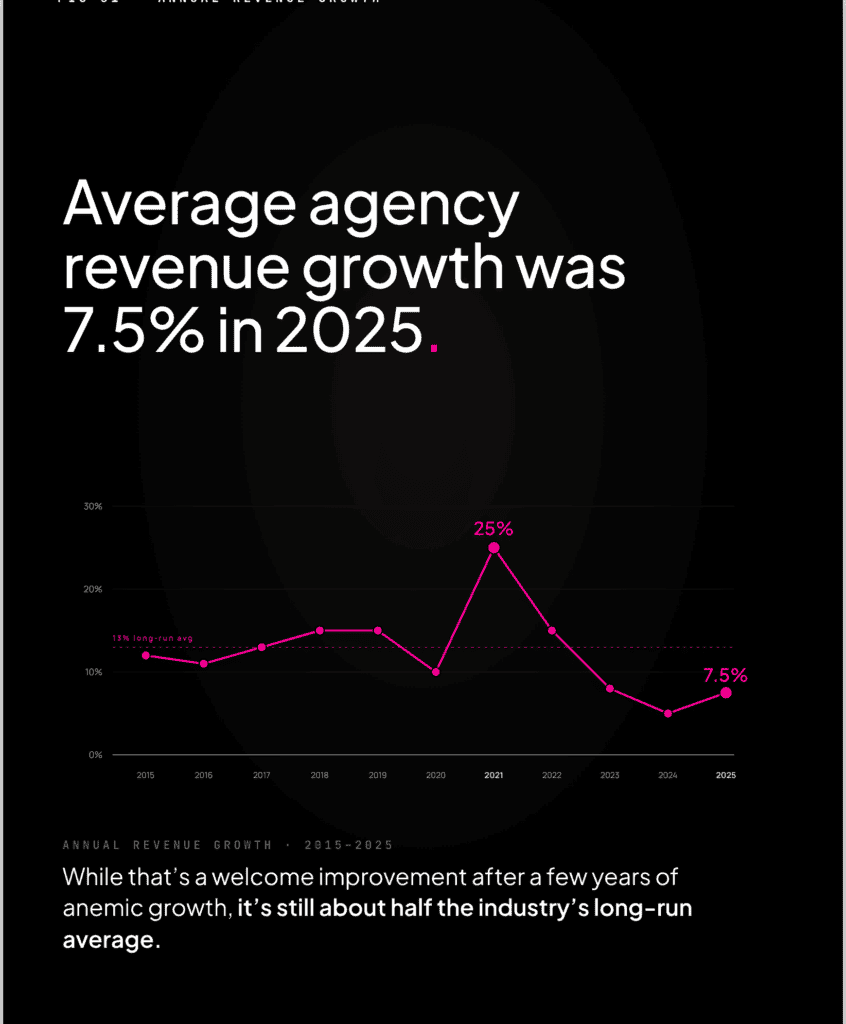
Average agency revenue growth
Average agency revenue growth was 7.5% in 2025, a welcome improvement after a few weak years but still about half the industry's long-run average. From 2015 to 2020, average annual growth ran around 13%. In 2021, the pandemic pulled forward demand and pushed average growth to 25%. Growth then slowed each year through 2024, bottoming at 5%, before the rebound to 7.5% in 2025.
The average agency invests 7% of revenue in sales and marketing. That level has historically produced 13% average growth. In weaker years, the same spend yields about half as much. LTV/CAC is the more useful lens: once an agency can quantify each client's value and the cost to acquire one, every dollar of revgen spend can be judged against its return.
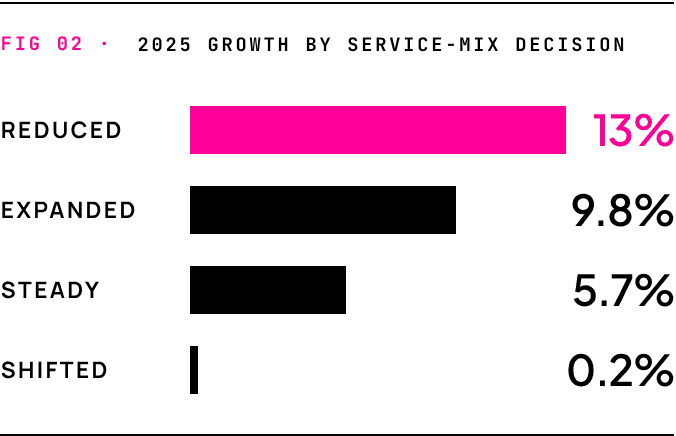
Service mix and growth
The average agency offered 6.6 services in 2025, up slightly from 6.3 in 2024. The raw count barely moved, but how agencies managed their mix had a large effect. Agencies that reduced their service offerings grew the fastest at 13%, almost twice the industry average. Agencies that made deliberate decisions about their mix outgrew those that drifted, and the biggest gains came from focusing.
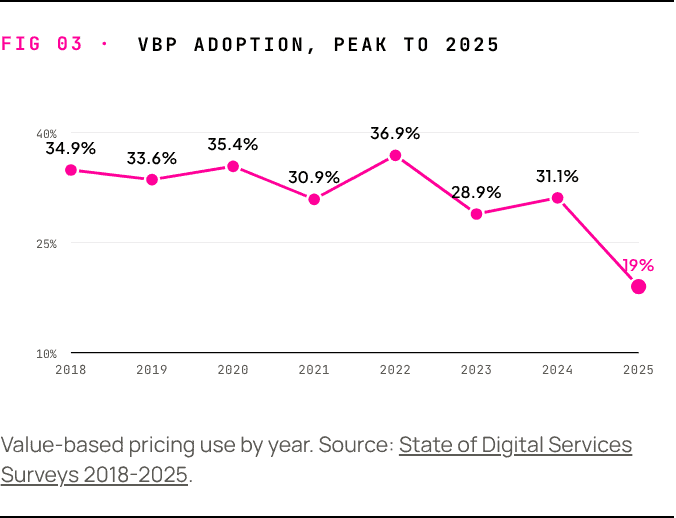
Pricing methods and the reversal of value-based pricing
Most agencies use a mix of pricing methods, most commonly Time and Materials, Fixed Bid, and Retainer, with only about 8% relying on a single model. The big pricing story of 2025 is the reversal of value-based pricing. VBP usage peaked at 37% in 2022, then fell to 18% in 2025, down from 31% in 2024. For the first time, agencies still using VBP grew more slowly than those that did not. AI has compressed execution times, buyers have become more cost-conscious, and the prerequisites for VBP have gotten harder to demonstrate.
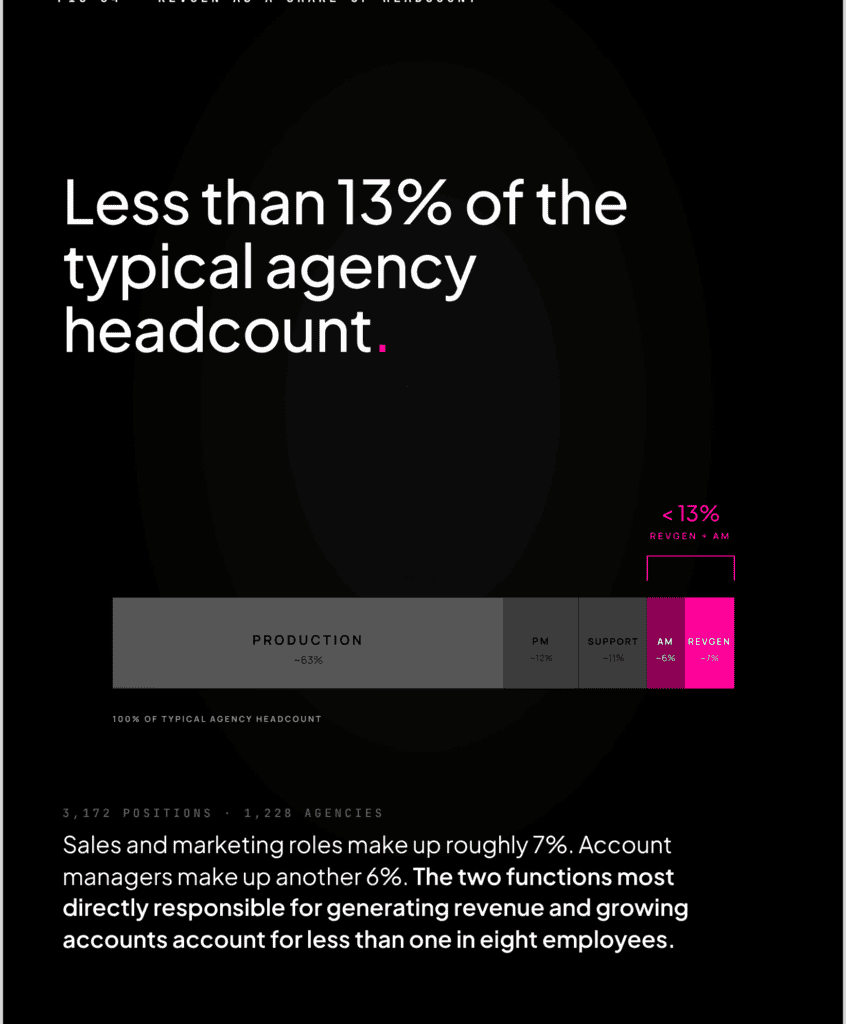
Revenue generation as a share of headcount
Across 3,172 employee positions at 1,228 agencies, revgen and account management combined account for less than 13% of the typical agency's headcount. Sales and marketing make up roughly 7%, and account managers another 6%. The two functions most directly responsible for generating revenue and growing accounts are less than one in eight employees.
How the revgen org evolves with size
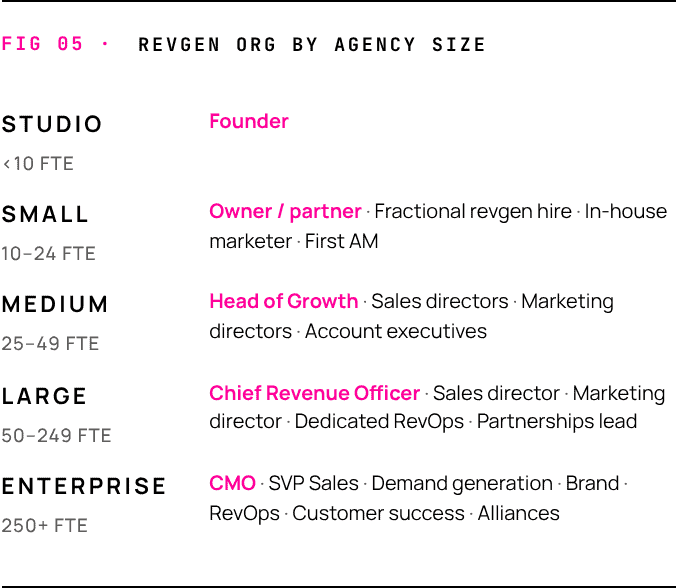
The revgen organization changes as agencies grow, from a solo founder at Studio shops, to a first account manager and in-house marketer at Small agencies, to a Head of Growth at Medium, a Chief Revenue Officer at Large, and fully specialized revenue leadership at Enterprise. Even at the top, partners still come in to close large, transformative accounts.
Contractor reliance
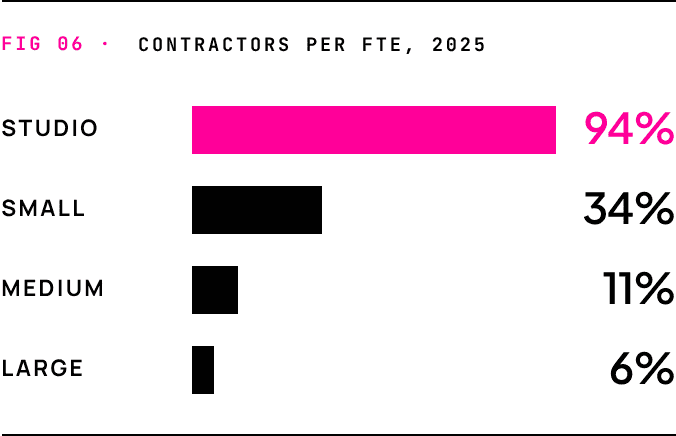
Contractor use has risen sharply since 2022. Studio shops now run with contractor benches equal to 94% of FTE on average, while Large agencies use them far more sparingly at 6%. This widens the range of demand a revgen system can plan against without overhiring, and frees up the capital that funds the marketing, sales, and account management investments an integrated system requires.
03
Why revenue generation is broken at most agencies
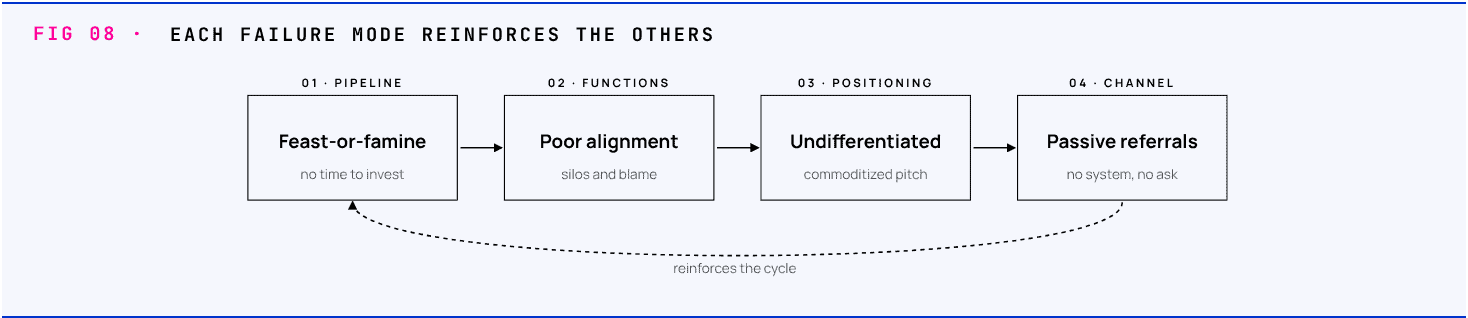
Growth at many agencies is fundamentally broken. Four failure modes show up again and again across our consulting work and research, and AI is making all of them worse.
Feast-or-famine
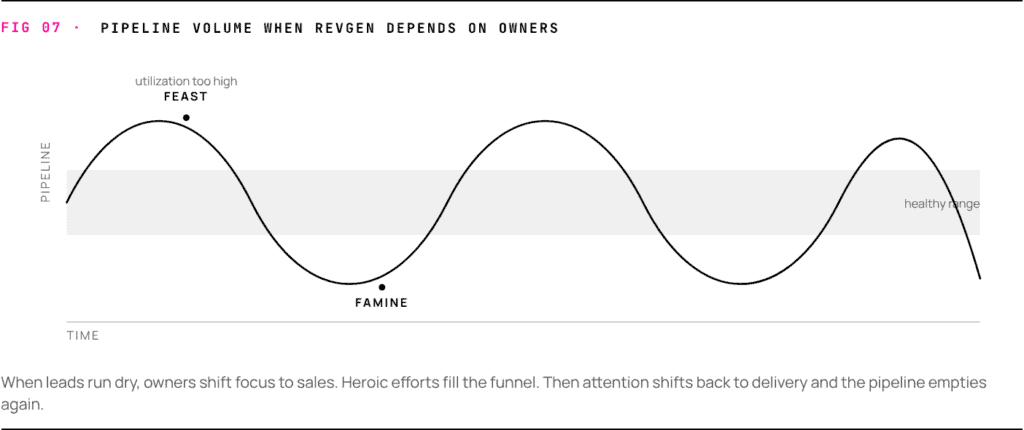
Inconsistent revenue usually traces back to overreliance on owners and partners for lead generation and sales. When leads run dry, owners shift focus to sales, the pipeline fills, then their attention shifts back to delivery and the pipeline empties again. The result is a roller coaster that makes forecasting and capacity planning nearly impossible. AI has made the famines hit harder, as buyers push on price and shortlist agencies with less human involvement than before.
Poor alignment and undifferentiated positioning
Too many agencies have revgen functions that work against each other, operating as silos that share customers but not information. That drops conversion rates and raises the cost to acquire and serve each client. Most agencies also go to market with positioning that does not separate them from the dozens of similar shops chasing the same buyers. AI makes both worse: buyers shortlist with AI, which filters out generic positioning, and routine deliverables have been commoditized, compressing pricing power for anyone competing on execution alone.
Passive referral handling
Referrals consistently rank as the most effective revgen channel, yet most agencies treat them as passive. Nobody owns them, measures them, or systematically asks for them. The agencies that have systematized referrals are pulling ahead, especially as reach-based channels degrade and AI cannot generate trust-based referrals the way it generates emails.
04
Strategy and positioning come first
Strategy and positioning sit underneath every revenue activity in this guide. Without a clear direction, the system will not work: marketing lacks a unique message, sales cannot identify target prospects, and account management does not know which clients to grow. The common mistake is setting positioning at a leadership offsite, posting it on the website, and never updating it. Treat it as a living stance reviewed quarterly against won and lost deals.
Sell against the problem space
The problem space is everything that surrounds the challenge a buyer is trying to solve. When a buyer asks for a new website, the website is the requested deliverable. The actual problem might be a drop in organic leads, a sharper competitor, or a revenue target the current site cannot support. Agencies that sell against the problem space compete on expertise and outcomes, a market with better margins, longer tenure, and far less price sensitivity than competing on deliverables alone.

"When you start marketing the problem, people assume you have the solution."
DuBois uses the PRISM model to stress-test whether a problem is worth positioning around: is it Painful, Recurring, Impactful, Solvable, and Marketable. Give the problem a name and the prospects who book calls arrive warmer and close faster.
The specialization shift
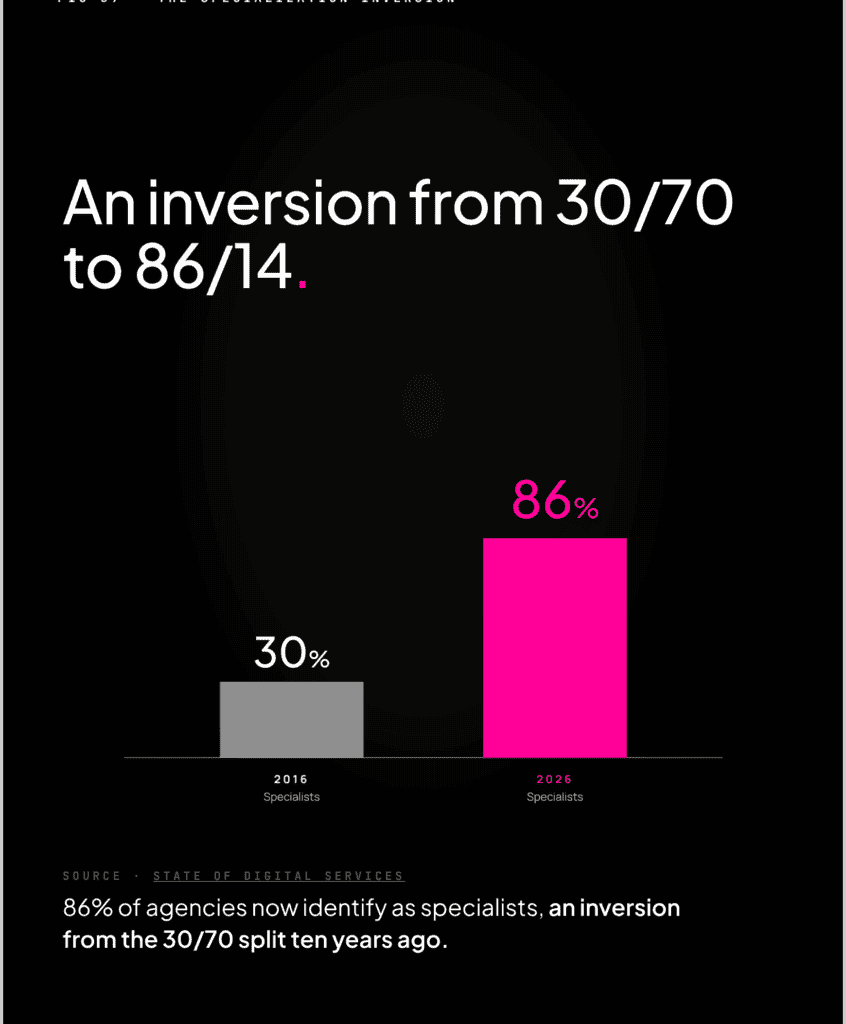
Specialization is now the standard. 86% of agencies identify as specialists, an inversion from the 30/70 split ten years ago. Industry depth is the more resilient choice, particularly as AI diminishes the value of individual services. Agencies specializing in both service and industry earned average client lifetime revenue 17% higher than the industry average, and AI is collapsing the price of implementation but not the price of expertise.
05
How digital agencies actually grow
The most effective revgen tactics in our research are relationship-based. Account management activities and client referrals sit consistently at the top, with partner referrals, upselling, and cross-selling rounding out the top five. The ranking shifts with two factors: the size of the agency's typical client and the level of sales complexity.
Sales complexity narrows what works
We measure sales complexity by multiplying the sales cycle in months by the number of meetings required to close. In low-complexity environments, nine tactics scored above the effectiveness midpoint. In high-complexity environments, only three worked: growing current accounts, client referrals, and partner referrals. Client referrals and growing current accounts were the only two tactics that scored above the midpoint at every level of complexity. No other tactic did.

An evolving buyer environment
Buyers are more cautious and project-oriented, running more competitive processes and using AI to research and shortlist agencies. Outbound is noisier, and content and SEO have been commoditized. Referrals and account management have held up, because trust-based channels have not degraded the way reach-based channels have.
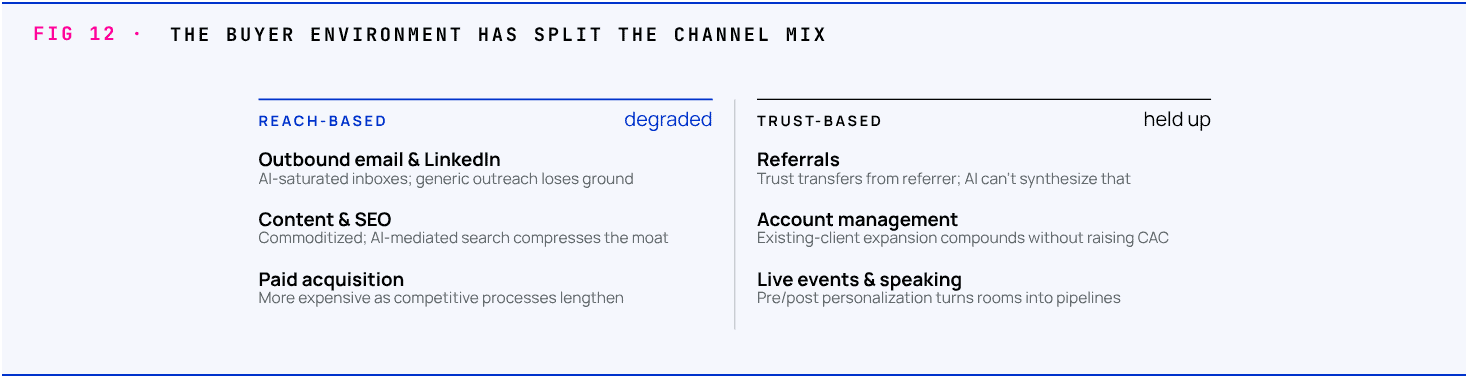
Trust-based channels have not degraded the way reach-based channels have. The agencies that operationalized referrals and account management early are pulling ahead of the rest of the market.
06
The integrated revgen system
The most effective way to manage revenue generation is to unify the four functions into a single function tasked with profitably growing the agency. One group, one goal. Building the four functions out individually does not produce the same result. Adding headcount to a broken structure only produces a more expensive broken structure.
Elevate account management to peer status
In a typical agency, account management sits under sales and earns a pure salary, with the unspoken assumption that the work is administrative. Yet it is the most effective revgen category in our research. Elevating it means two changes: it reports directly to the Head of Growth or CRO alongside the other functions, and it gets a seat at strategy, ICP, and service-mix decisions.
Achieve marketing-sales parity and remaster the metrics
Agencies tend to be sales-led because sales creates revenue quickly. After about 50 FTEs, agencies need a marketing function on par with sales, with a real seat at the table, budget authority, and accountability for revenue outcomes. The group then needs shared metrics, owned by the CEO or Chief Growth Officer, so the four functions can see each other's numbers in real time and diagnose problems together.
07
Growing through account management
Account management is the highest-leverage revenue function in our research, and the most underdeveloped. It tends to be staffed late, treated as administrative, and held accountable for very little.
The economics of LTV and CAC
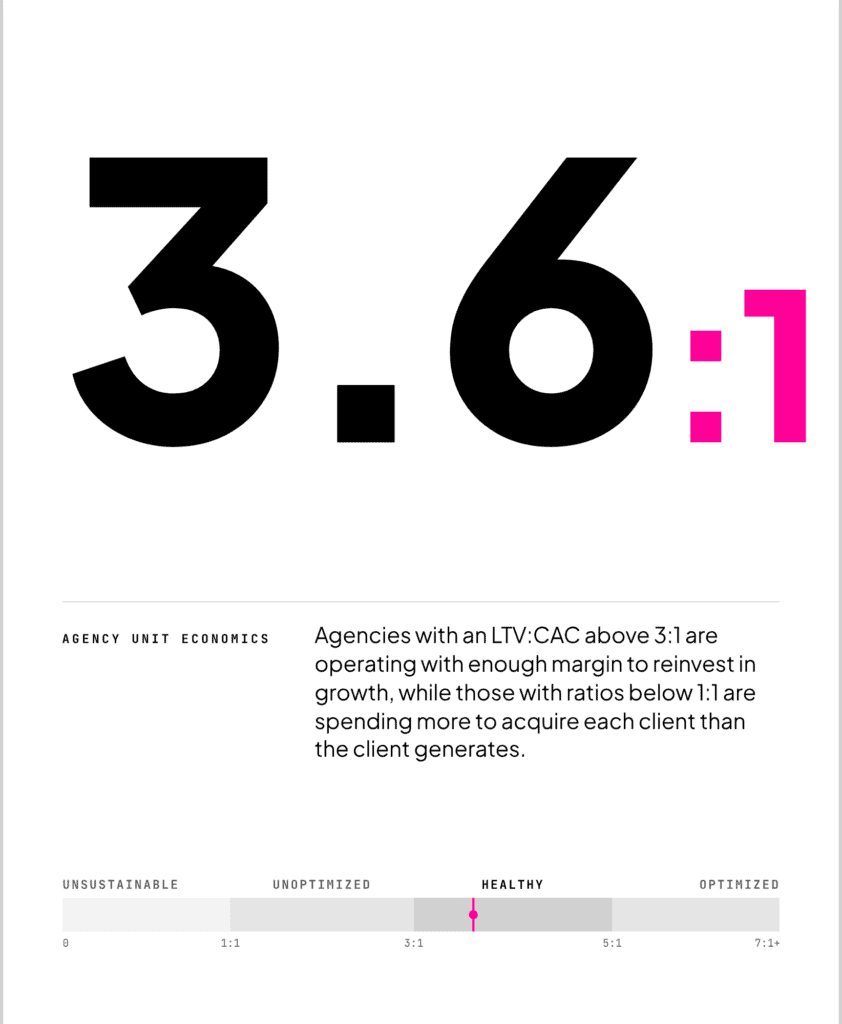
The job of account management is to maximize the gross margin a client produces over the life of the relationship, relative to the cost to acquire that client. A $2M agency spending 7% of revenue on sales and marketing acquires about 11 new clients a year, for a CAC near $12,500, and a lifetime value near $45k, a 3.6:1 ratio. Agencies above 3:1 have enough margin to reinvest in growth. Those below 1:1 spend more to acquire a client than the client returns.
Retention beats acquisition
Retaining a client costs a fraction of acquiring one, because the activities that drive retention are optimizations of work the agency already does. The math compounds: long-term clients refer new business, become case studies, and expand their engagements. Across the industry, 42% of agencies report an average retainer tenure over two years, while a quarter of engagements end within a year.
Client tiering and the grow-or-exit mentality
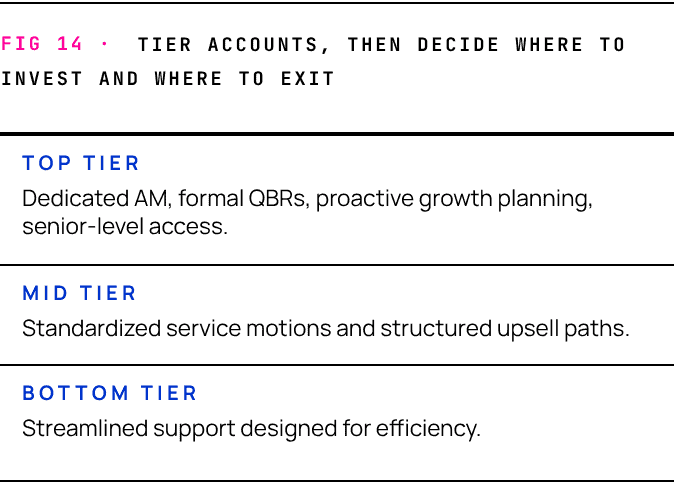
Client tiering organizes accounts by revenue, profitability, tenure, growth potential, and strategic fit. Top-tier clients get dedicated account managers and formal QBRs, mid-tier clients get standardized motions and upsell paths, and bottom-tier clients get streamlined support. The grow-or-exit mentality uses tiering to decide where to invest and where to restructure or exit, freeing capacity for higher-return relationships.
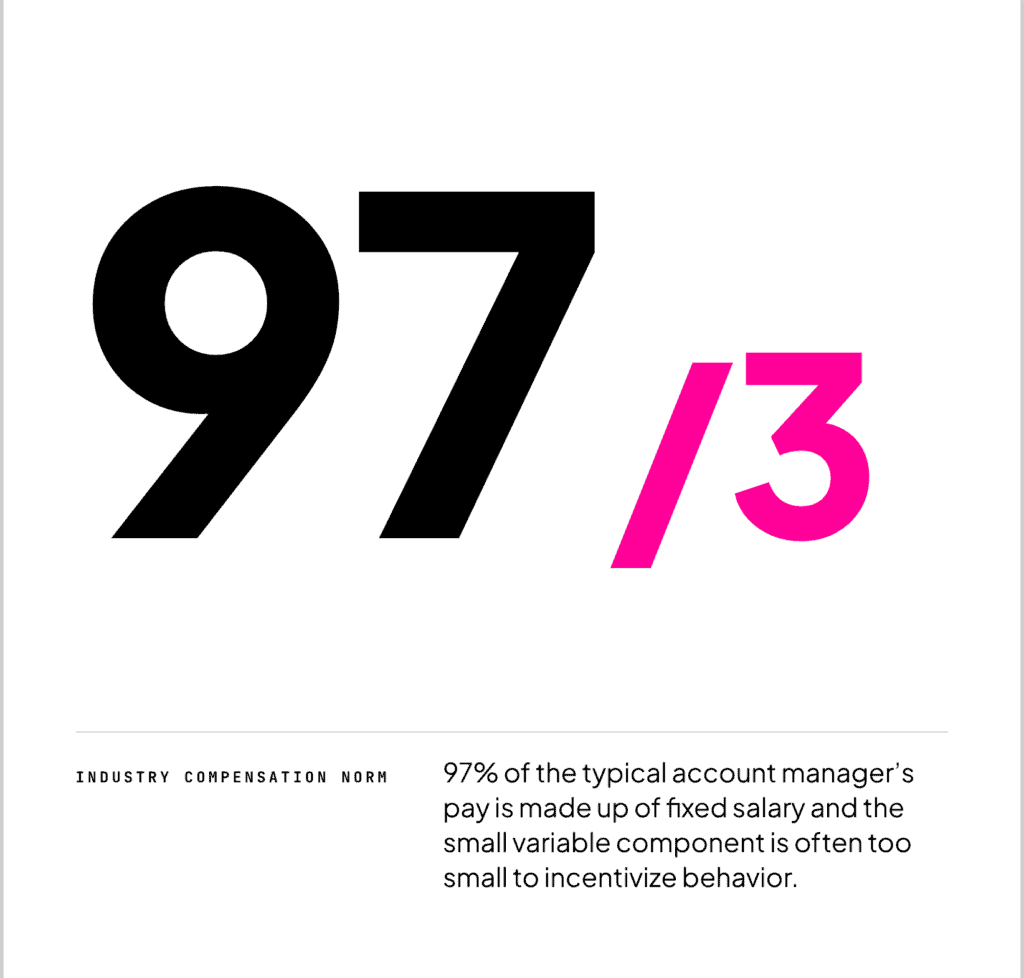

Before setting compensation, agencies need to define what they want the role to do, because 'account management' is a catchall for retention, relationship stewardship, strategic consulting, and upselling. A retention-focused role might stay near 85/15 or 90/10, while a role with real growth responsibility moves toward 75/25 or 70/30. Gradual transitions over one to two years tend to work better than abrupt redesigns.
08
The referral engine
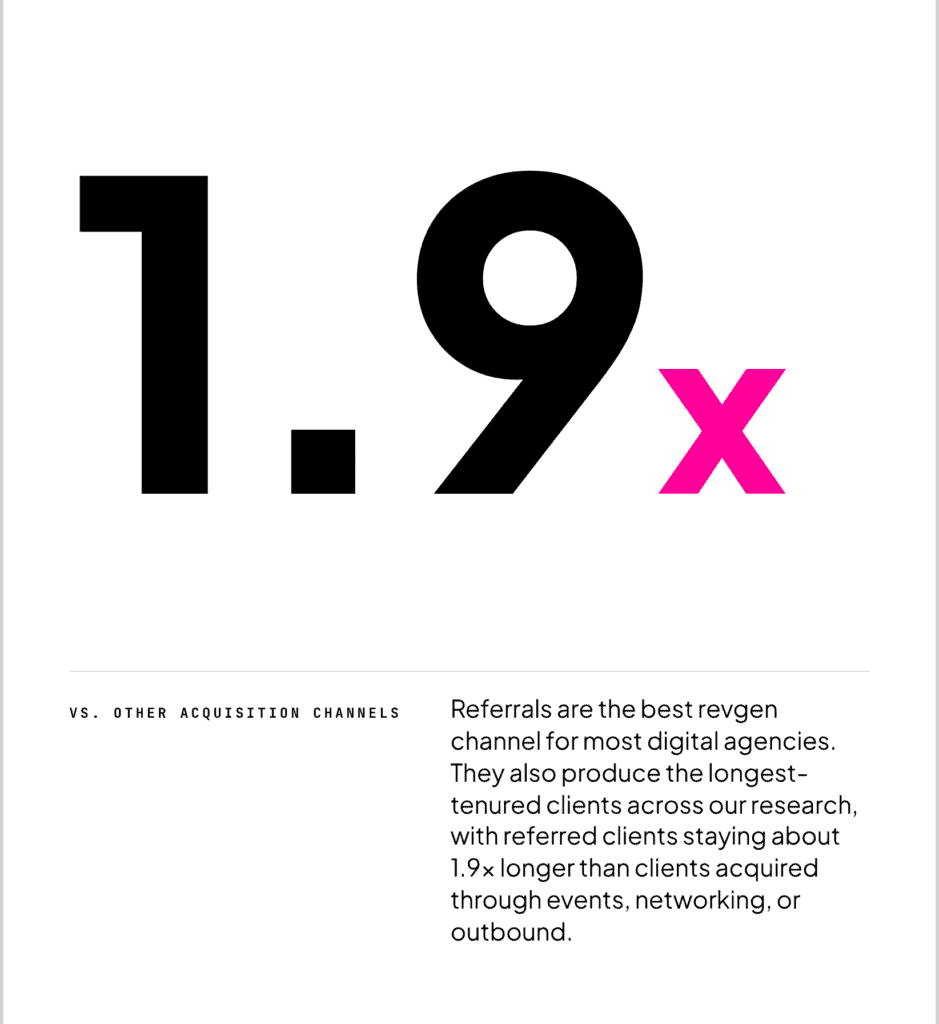
Referrals are the best revgen channel for most agencies. They produce the longest-tenured clients in our research, with referred clients staying about 1.9x longer than clients acquired through events, networking, or outbound. They also come with higher close rates, larger deals, and lower acquisition costs. Most agencies still treat them as passive, which is exactly where the opportunity lies.
Four prerequisites and five sources
Even the best system cannot compensate for missing fundamentals: good work and happy clients, strong positioning, defined ICPs, and available capacity. Referrals come from five sources, each with its own dynamics: current clients (the highest trust), past clients (best approached 6 to 9 months after a project closes), business partners, other non-competing agencies, and personal connections (the lowest priority).
The Ideal Referrer Profile
The Ideal Referrer Profile (IRP) is the referral-side counterpart to the Ideal Customer Profile. The ICP defines who the agency sells to. The IRP defines who can reliably introduce the agency to those buyers. A solid IRP captures five fields: persona, closeness to the ICP, trust and influence, motivations, and enablement potential.


Referrals already work for most agencies, they have just never been optimized. The most common failure is "giving partners homework," asking "do you know anyone we can help?" and forcing the contact to figure out who fits and write the intro. The better move is to ask for introductions to specific people and arm the referrer with a ready-to-send template.
09
AI inside the revenue generation system
A third of agencies have already implemented AI across operations, and another quarter is in the process. AI maturity is highest in text-heavy functions like copywriting, coding, and marketing, and lowest in relationship-heavy functions like sales and account management. That gap is where the operational opportunity lives.
Why sales lags
Sales sits at 1.5 on our maturity scale, well behind copywriting and coding, even though much of sales work is research, drafting, and follow-up. Sales has historically been a relationship function and many leaders read AI as a threat to it, the tooling is newer, and sales is the function most affected by AI in the buyer's environment. Closing this gap is one of the highest-leverage AI investments most agencies have after production.

Pricing pressure and the shift to strategy
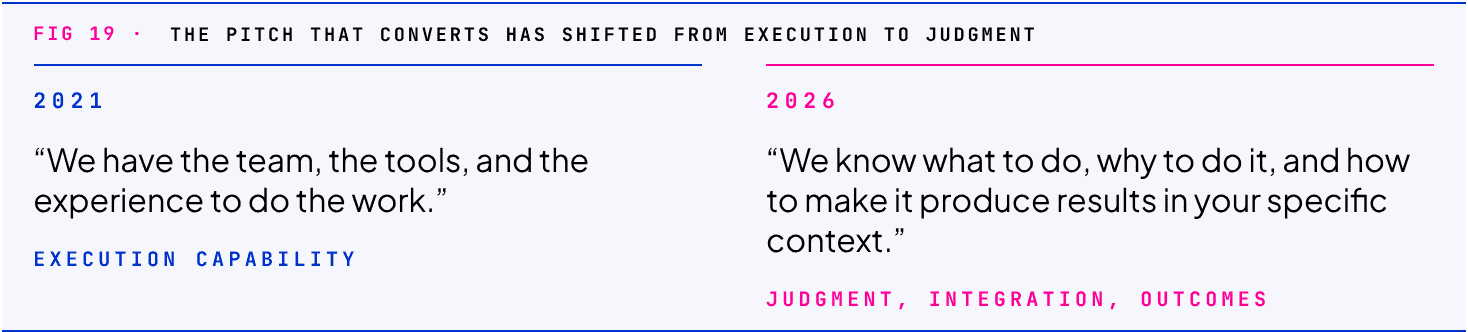
AI pressure shows up first in time-and-materials billing. If the same output takes fewer hours, agencies that charge by time lose revenue every time they get more efficient. The pitch that converts has shifted with it. The 2021 pitch led with execution capability. The 2026 pitch leads with judgment, integration, and outcomes: knowing what to do, why to do it, and how to make it produce results in the client's specific context.
10
Where the agency market goes from here
The agencies that come out of this era stronger will be the ones that stop treating revgen as four loosely connected functions and start treating it as one system. The gap between agencies that have embraced revgen best practices and those that have not is larger than most leaders realize.
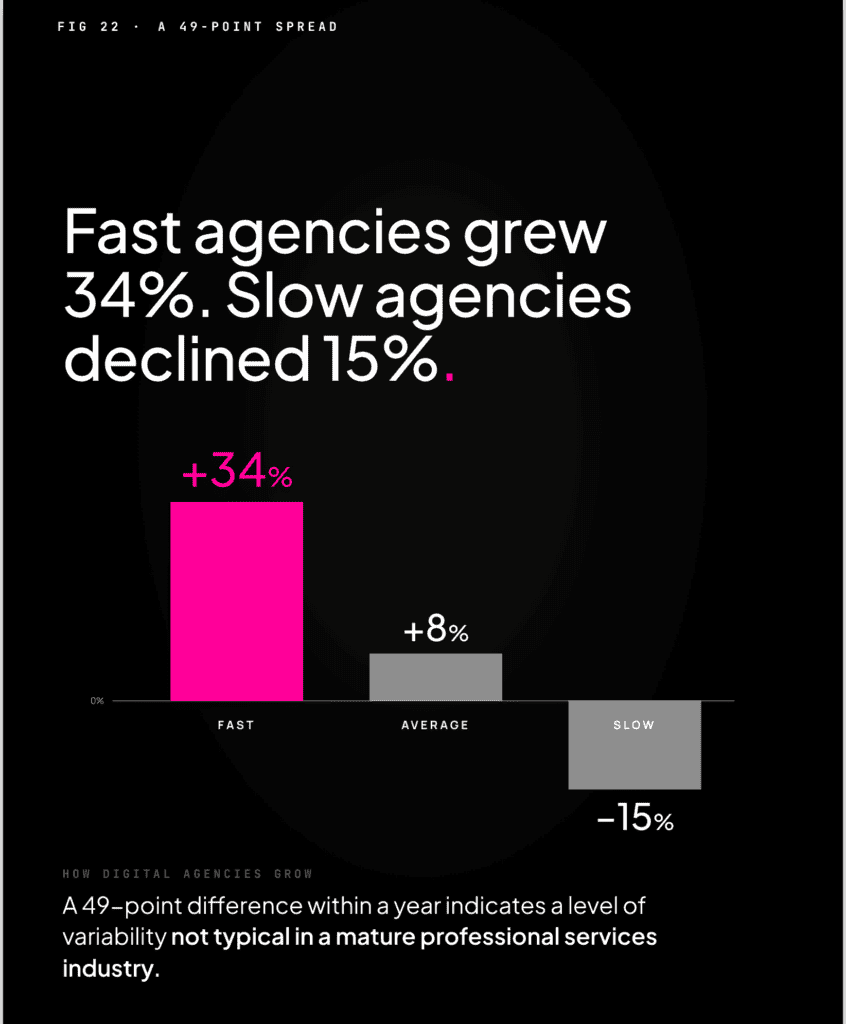
49-pt
Fast agencies grew 34%. Slow agencies declined 15%. A 49-point spread in a single year points to a level of variability not typical in a mature professional services industry.
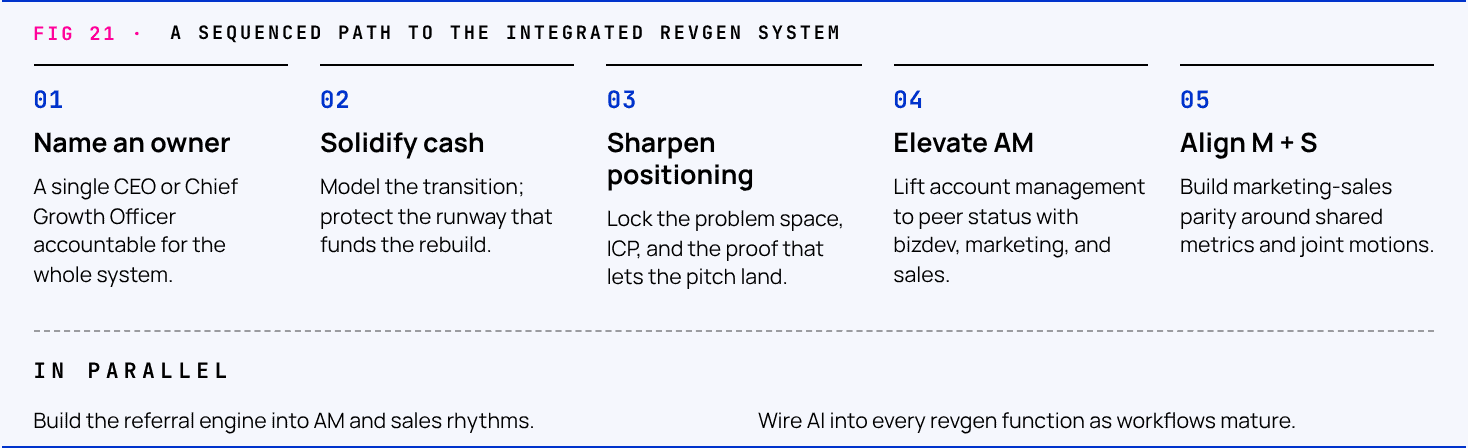
The early choices are similar across transitions: name a single owner for revgen, solidify the cash position, sharpen positioning and ICPs, elevate account management, and build marketing-sales parity, with the referral engine and AI integration running in parallel. Agencies that complete this work secure long-term structural advantages in growth, margin, and lifetime value.
Get the guide
Get the complete Digital Agency Growth Guide
The full 2026 edition includes the complete prerequisites, cash-flow modeling, role-by-size tables, source-by-source referral playbooks, and the contributor essays in full.
Need help putting this to work? Request a Digital Agency Growth Review.
FAQ
Common Questions
What is revenue generation (revgen) for a digital agency?
How do digital agencies actually grow?
How fast do digital agencies grow?
Why is revenue generation broken at most agencies?
What is a good LTV/CAC ratio for an agency?
Why is account management the highest-leverage growth function?
How important are referrals for agency growth?
How is AI changing agency revenue generation and pricing?
What does it take to build an integrated revgen system?
Who is this guide for?
Report Authors
About the Authors

Nicholas Petroski is the founder of Promethean Research, an industry research and consulting firm focused on digital agencies. Promethean has been tracking the digital agency industry since 2015, working directly with founders, partners, and revenue generation leaders on growth strategy and operational builds. The firm publishes annual research including the Digital Agency Industry Report and the State of Digital Services.

Meghan Goetz, managing director, leads Promethean’s agency growth solution practice. She has spent over a decade designing and building marketing departments for digital agencies as both a marketing director and a fractional CMO.
More articles



Contact Us
Get our latest research and insights on the digital agency industry
"Best / most valuable updates from anyone in ages, I get hit up sooooooo much keep this kind of newsletter / value up."
Wil Reynolds
CEO, Seer Interactive