
Last month we ran our annual outlook survey in partnership with the Bureau of Digital, and the early results have been enlightening. BTW huge thanks to everyone who participated; we’ll be sending you the full report out in a few weeks.
We’ve been tracking pricing methodology in those surveys, and this year we added hourly rate data to the mix.
In this newsletter, I want to run through a bit of what we’ve learned over the years about methodologies and rates and how they relate to a shop’s overall strategy. To keep this brief, we’ll look at this in the context of the three most common goal archetypes we’ve come across: Lifestyle, Sustainable Growth, and Rapid Expansion.
Lifestyle – Typically, a smaller shop with <25 FTEs where the owners are still partially involved in the service delivery. They want to keep doing the same kind and amount of work that they’re currently doing and aren’t interested in reinvesting too much in growing the firm—low-risk tolerance.
Sustainable Growth – Can be a shop of just about any size where the owners are interested in growing at roughly industry average. They’ll invest in growth, but the risk/reward calculation needs to increase value more often than not—medium-risk tolerance.
Rapid Expansion – We typically see this goal among shops in the 25-75 FTE range where the owners are building to sell the business in 3-5 years, and they want to maximize their sale price. They’ll invest heavily in growth, often seeking outside capital, and are comfortable taking on significantly more risk—high-risk tolerance.
How does pricing fit into this?
Our research shows that different pricing methodologies correlate to different growth rates. Furthermore, the average shop uses three different methodologies: a mix of retainer, fixed bid, and time & materials. We have historically seen value-based pricing employed by only ~1/3rd of the shops we survey.
The type and mix of pricing you employ will directly impact your firm’s growth trajectory, and this needs to sync with your firm’s goal archetype.
If you select a pricing mix that’s lower risk and grows more steadily, but you position the rest of your business for rapid expansion, you’ll create tension in the firm and be less likely to achieve your goals. The same holds for the reverse.
Matching methods to goals.
Lifestyle – It’s probably obvious, but retainer-based pricing is the most stable pricing method. Unfortunately, this comes at the cost of growth. Retainer-based shops fare better in challenging environments (like 2020) but worse in growth environments (like 2021).
Sustainable Growth – This one is a bit trickier since several options will work equally well. We see shops running all kinds of permutations of retainer, fixed bid, and time & materials that end up growing at market rates. The secret here seems to fall in the actual rates being charged vs. the exact mix of pricing methods (more on this later). There’s often more room to maneuver here than in the Lifestyle/retainer space.
Rapid Expansion – Here’s where value-based pricing tends to shine. We’ve seen growth rates for shops using value-based pricing follow an almost inverse path of those using retainer-based pricing. In growth environments, value-based wins out substantially. In challenging environments, it fares the worst out of any pricing method. This gives the rapid expansion-seeking shops the ability to grow incredibly quickly, but the risk that comes with it will keep most lifestyle shops from employing it. The positioning required for VBP to work well is also a limiting factor.
On hourly rates
For three methods (retainer, fixed bid, and time & materials), calculating an hourly rate is absolutely necessary. While your firm’s positioning can allow mobility here, you’re still required to understand what the market’s willing to pay for the value you’re offering. This is so important to our clients that back in 2019, we started a massive project to map the hourly rates of as many digital shops as possible. Since then, we’ve compiled pricing data on over 30k digital agencies worldwide. This data has shown us that there is substantial pricing power left unused by many digital shops. (We recently began offering pricing benchmarks as a standalone service that can be purchased here)
To augment this pricing data, we asked about hourly rates in our 2022 Outlook Survey that we recently completed with the Bureau of Digital, and what we found shocked us.
In 2021, during the most intense pull-forward of digital spend maybe ever, only 40% of digital service shops raised their rates. 60% of agencies didn’t raise their rates during a year in which inflation in the U.S. hit a 39-year high. Pricing is an agency’s most powerful lever, and those that pulled it last year grew 20% faster than those that didn’t.
For the digital shops in our outlook survey, 28% priced their services in the $175-199/hr range, with the following most common brackets being $150-174 (22%) and $125-149 (19%). This is highly dependent on service mix though, so your shop’s pricing may differ. Those in our survey derive the bulk of their revenues from web design / development, UX design / strategy, and digital strategy.
In another survey we did, focused on social media and content marketing shops, the average pricing was significantly lower, with roughly half the agencies charging below $100/hr.
To sum it up.
Matching your pricing methodologies to your agency’s goals will reduce friction in your firm and allow you to reach those goals more smoothly. Use retainer-based pricing for more conservative goals and value-based for more aggressive. Understanding how your hourly rate relates to the overall market for your services and then capitalizing on gaps in pricing power can further boost growth rates. Most agencies still have room to raise prices.
Data Point
Recent survey results, benchmark data, industry metrics, analysis, and new survey opportunities.
Percent of shops raising prices in 2021 by size cohort.
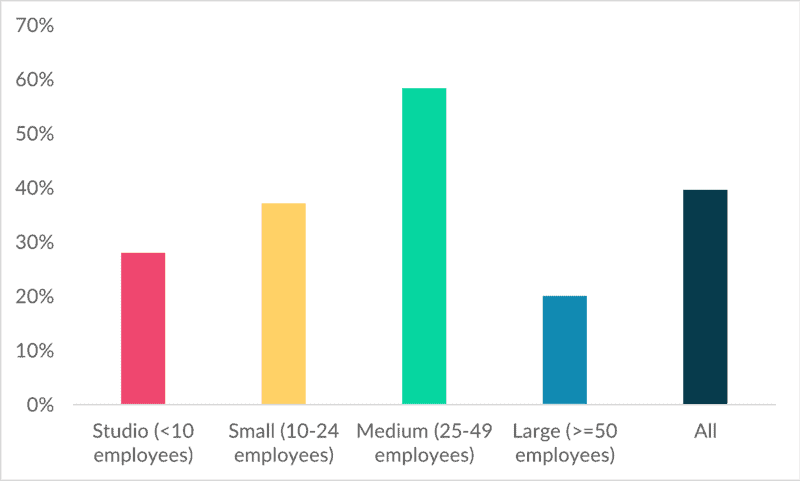 |
40% of digital shops in our latest outlook survey raised prices last year. The percent of which varied significantly by size with 58% of Medium shops raising prices and only 20% of Large shops.
New Insights
The latest articles from our site about running a digital agency.
 |
Financial Metrics for Marketing AgenciesMonitoring the right metrics can make growing a digital agency significantly easier. By regularly monitoring them, and asking the right questions, they can reveal where you should focus your team.
|
 |
How to Master Qualifying CustomersQualifying customers through a well-honed points system can improve lead quality, save resources, and glean better clients.
|
 |
Understanding Your Agency’s Employee Utilization RateEmployee Utilization Rate is a key indicator of your organization’s overall health. If you don’t fully understand this metric, it is difficult to make informed decisions about your agency’s efficiency and effectiveness.
|